





 Japanese Studies & International Dialogue Navigation
27/07/2026
Our new Essay Series, "Japan Up Close" aims to highlight the work of researchers undertaking Japan-related work at universities around the UK. Each essay is designed to be concise and accessible, offering a close look at Japanese society, culture, and their historical and contemporary contexts through the lens of academic research. The format includes three main sections; "Observing Japan", "Rethinking Japan" and "Looking Beyond Japan", to guide readers from an observation to broader interpretation and reflection.
Vol. 1 is Observing Japan: Encountering Concrete Castles for the First Time
by Prof. Oleg Benesch, Professor and Head of the Department of History, University of York.
We would be very grateful if you could complete our brief survey on how you found our Essay series.
Please click here to access the survey once you have finished reading the essay.
Read Vol. 1 below!


Following a brief visit to Japan in the 1990s, I moved to Okazaki in Aichi Prefecture in 2000 to study at a Japanese language school. As I was living on a bit of a shoestring, I didn’t venture much further afield than Nagoya and the surrounding area during my first 18 months in Japan. In July 2001, a group of us from the language school decided to see the annual grand sumo tournament at Nagoya, as we had heard that one could easily get cheap tickets for the morning sessions before the more famous wrestlers made their appearance in the afternoon.
While I was intrigued seeing sumo live for the first time, the other thing I remember from that day was visiting the keep (tenshu) of Nagoya Castle, which is just a few steps away from the Aichi Prefectural Gymnasium, where the tournament was held. I was very impressed by the massive walls and moats of the castle, and struck by the scale of the site and the height of the keep itself. I confess that my bubble was at least partially burst when I entered the keep, however, and realized that it was actually a somewhat worn concrete reconstruction of the original, albeit with great views of the city from the top. I felt a bit let down, and didn’t think much more about castle keeps, also because the one back in Okazaki similarly turned out to be a modern building made from steel-reinforced concrete.
The following year, I had the chance to visit Himeji Castle, which has the most famous of Japan’s remaining premodern wooden keeps, and my view on castles changed completely. The keep of Himeji Castle, which is a UNESCO World Heritage Site, is a beautiful and imposing structure in a dramatic location above the city. It also made me appreciate the many concrete castle keeps as I could now imagine what had apparently been lost and rebuilt.
Over the next decade, I visited dozens more castles throughout Japan, from Okinawa to Hokkaido, including most of the twelve remaining “original” premodern keeps. When I visited modern concrete structures, which usually housed local history museums, I appreciated the displays and the views from the top, but didn’t give them much more thought beyond noting external elevators and other architectural quirks.
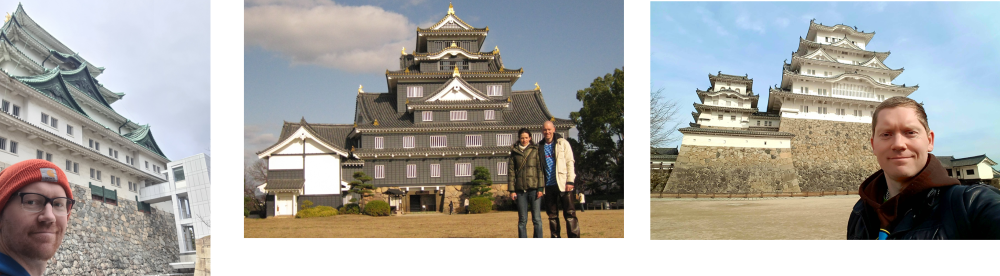
From left to right: Nagoya Castle, Aichi Prefecture, 2022; Okayama Castle, Okayama Prefecture 2009; Himeji Castle, Hyogo Prefecture, 2018.

Tenshu: usually translated as “keep” or “donjon”, the tenshu is the central tower and most prominent structure of many Japanese castles, and is often seen as synonymous with the castle as a whole. The most famous tenshu was built by the warlord Oda Nobunaga (1534-1582) at his Azuchi Castle in the 1570s. Although it was destroyed after Nobunaga’s death in 1582 and there are many debates about its exact appearance, it is often seen as the origin of tenshu in Japan and the catalyst for a tenshu-building boom in the following decades.

While I enjoyed visiting castles as a tourist, my interest in them as a researcher really began in 2013 with a chance meeting with Ran Zwigenberg, a fellow historian who had also recently finished his PhD, and is now a professor at Pennsylvania State University. In that initial conversation, we came upon the question of why there were so many concrete castles in Japan. While conducting his award-winning research on Hiroshima and memory, Professor Zwigenberg had come across heated debates in Hiroshima in the 1950s regarding the reconstruction of the Hiroshima Castle keep, which had been destroyed by the atomic bomb in 1945.
Together, we decided to pursue this topic further, and realized that the local conflict over the castle in Hiroshima was repeated throughout the country, from large cities like Nagoya to small towns like Aizu-Wakamatsu. A popular narrative holds that many of Japan’s tenshu were destroyed by bombing in 1945, but in fact only six keeps were lost during the war years. The vast majority of castle structures had been destroyed immediately after the Meiji Restoration of 1868 as part of the wholesale modernization processes that shook the country.
Many castle sites were repurposed as military garrisons for the new Imperial Army, and premodern structures were torn down to make room for barracks, arsenals, and parade grounds. By the time a concerted effort at heritage preservation began to emerge in Japan in the 1880s – simultaneously with developments in many other countries in Europe and elsewhere – countless structures had already been lost.
After 1945, the major urban castle sites were demilitarized and turned into parks, universities, heritage sites, and other public spaces. As part of this shift, the 1950s and 1960s saw an unprecedented castle-building boom, as dozens of concrete tenshu were built across Japan to recapture local pride, symbolize postwar recovery, and draw tourists from home and abroad. Now, almost 70 years on, these structures may seem odd, as they did to a younger me. They should not be dismissed simply as “inauthentic” versions of premodern wooden tenshu, however, but rather as valuable sites for understanding Japan’s complex modern history, and how that has been remembered, contested, and recast over the past 150 years. This contestation continues today in sites such as Nagoya, where the 1950s concrete tenshu has been condemned, and grand and controversial plans have been made to reconstruct it from wood in an “authentic” manner.

Although they seemed unusual to me at first, Japan’s concrete castle keeps are the product of much larger global debates on history and heritage that were not unique to Japan. On the contrary, the destruction of premodern castles in the nineteenth century echoed developments in the UK and across Europe, as older structures were demolished with little remorse to make way for railways, roads, and industry. Ideas around the value of heritage and its preservation were discussed simultaneously in Japan and Britain around the turn of the twentieth century. The two countries were firm allies and had many cultural and intellectual exchanges, and were especially keen to celebrate one another’s medieval pasts, drawing comparisons between idealized knights and samurai.
Similarly, the large-scale loss of castles and other architectural heritage in the Second World War affected much of Europe, as well. Many countries saw heated debates about whether or not to reconstruct lost buildings, and if so, whether to use concrete or traditional materials. As in Japan, many castles in Britain and the rest of Europe should also be considered as witnesses of their turbulent modern history, rather than as unmediated evidence of the premodern past.


Prof. Oleg Benesch (Professor and Head of the Department of History, University of York)
Discipline/Speciality: Japanese History
Together with Ran Zwigenberg, Oleg published Japan's Castles: Citadels of Modernity in War and Peace in 2019, and together with Rosina Buckland, the book Samurai to accompany the British Museum Special Exhibition in 2026. For more on Oleg's research, see www.olegbenesch.com.
More about the Author: Japan Foundation Researcher Directory
https://jpf.org.uk/japanese-studies-survey-researcher-directory.php
Thank you for reading this essay!
We would be very grateful if you could complete our brief survey on how you found our Essay series.
Please click here to access the survey once you have finished reading the essay.




 The Japan Foundation, London